White Claw and the Story the Industry Told Itself
What the hard seltzer boom reveals about how market research can fail the people who rely on it
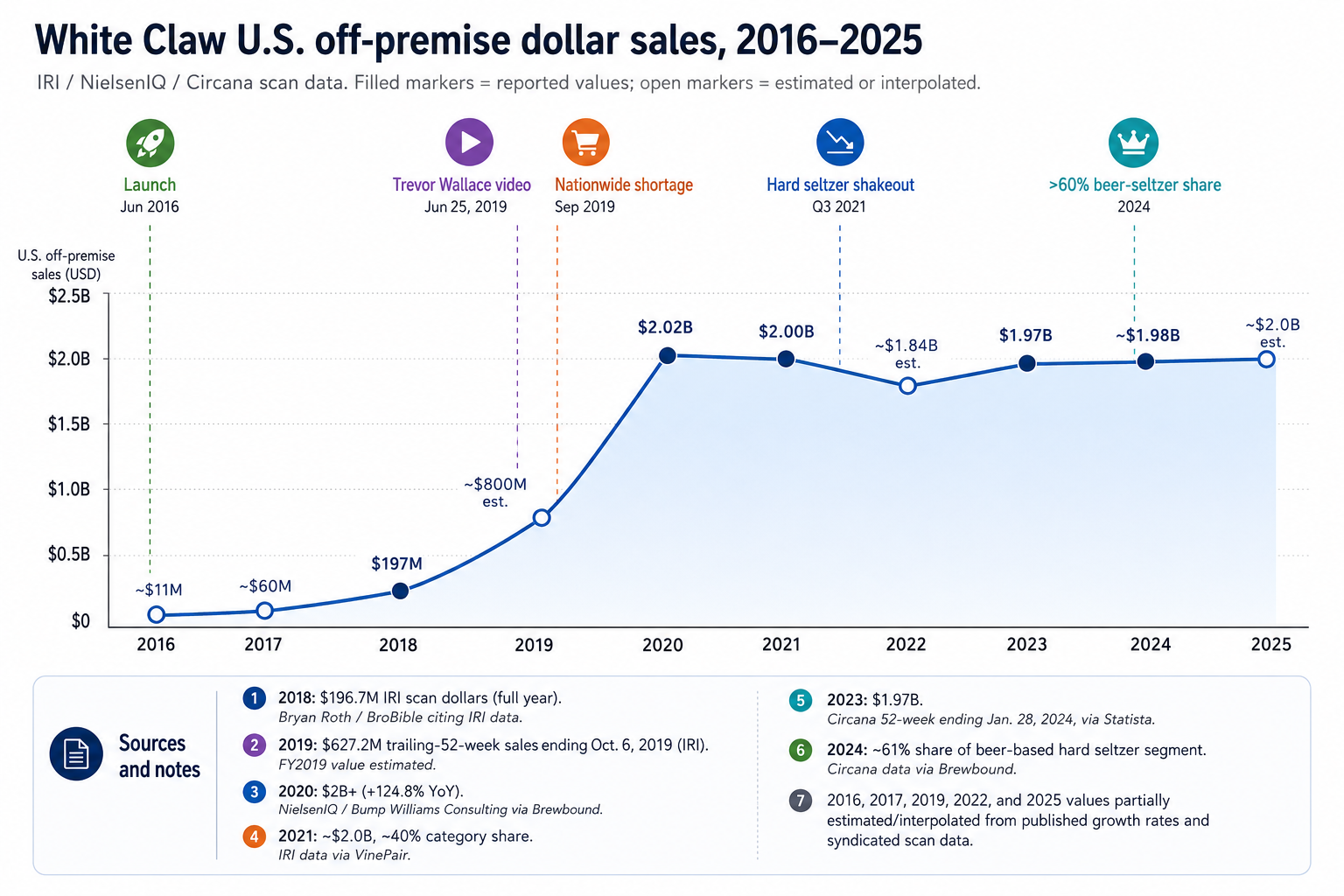
In the summer of 2019, you could not go to a pool party, a music festival, or any outdoor gathering of people under forty without encountering White Claw. Hard seltzer had been building for a few years at that point and by 2019 it had its zenith. White Claw dollar sales hit $327.7 million in July alone, up 283% year over year (CNN Business). By the end of that summer, White Claw was commanding more than half of total US hard seltzer dollars. There was a nationwide shortage. The brand had been on allocation since September of 2018 (CBS News).
The category that grew up around it was enormous. Off-premise scan data puts the US hard seltzer market at $1.5 billion in 2019, then $4.1 billion at its peak in 2020 (NielsenIQ). The growth rate was one of the fastest ever documented for an alcohol category. Investor enthusiasm was, to put it charitably, considerable.
And then it stopped. By Q3 2021 the category was visibly contracting. Brands were destroying unsold inventory. Write-downs ran into the hundreds of millions of dollars. Many of the competitors that had rushed into the space folded within eighteen months. What looked like a permanent category shift turned out to be a wave, and a lot of people who had bet heavily on the wave got hurt (Brewbound).
What happened, and why, is an interesting question. But the more interesting question, to my mind, is why the research and insights industry got the story so wrong for so long. Because it did. An industry that exists to help companies understand their consumers produced a near-unanimous verdict on why hard seltzer was growing, and that verdict turned out to be wrong.
The Puzzle at the Heart of the Category
The conventional story of hard seltzer says that the category grew because consumers, particularly younger consumers, were becoming more health conscious. They wanted lower calories, fewer carbs, and lighter options that fit with a wellness-oriented lifestyle. And the data, apparently when looking across surveys, analyst recommendations and trade press commentary all backed it up. The official narrative was virtually unanimous.
Except, if the “better-for-you” positioning was the real driver of purchase, you would expect the brands that leaned hardest into that positioning to do best. And you would expect, once the health narrative was well established, for the category to keep growing as health-consciousness continued its long march through consumer culture.
Neither of those things happened. The brands that leaned hardest into health-forward positioning underperformed, and several of the most conspicuous health-positioners collapsed entirely (Food Dive). And the category stopped growing despite continued interest health and wellness. Indeed, growth appears to have stalled during the onset of the COVID-19 pandemic, a time of exceptional attention to health outcomes. White Claw, the dominant brand in the category, built its reputation not on health claims but on something that looks much more like pure cultural moment. And, I would argue, the story of hard seltzers is really, just a story of White Claw and a halo effect bringing up a few tag-alongs.
The Launch and the Better-For-You Thesis
White Claw launched in June 2016 with three flavors, 5% ABV, 110 calories, gluten-free, and a suggested retail price of $9.99 for a six-pack (Brewbound). At the time, the brand’s SVP of marketing described it as “a shift into a lighter, all natural, better-for-you alcoholic beverage, defining a whole new category for those who want to enjoy life and have fun while maintaining a healthy lifestyle.” One flavor was described as “a refreshing post-yoga sip.”
White Claw’s original strategy was clearly built around a “better-for-you” proposition. But that idea was not unique: Truly had entered the market about eleven weeks earlier, and the category was already being framed around the same health-focused attributes. So, the premise that health consciousness would fuel hard seltzer expansion was there from the start.
However, real growth appears to have tracked a different trajectory.
The Summer Everything Changed
On June 25, 2019, a comedian named Trevor Wallace posted a video called “drinks White Claw once” to YouTube, Twitter, and Facebook (Trevor Wallace, YouTube). One day after the brand’s third anniversary. The video’s central joke was the performative masculinity of a certain kind of White Claw enthusiast, with the now-famous line “Ain’t no laws when you’re drinking Claws” deployed as a kind of ironic battle cry. It was funny, it was extremely shareable, and it captured something about the social experience of drinking the product that no brand campaign had managed to articulate.
The view counts compounded fast. Around 1.1 million views by mid-July. Close to 3 million by October. Four to six million by 2020 (VinePair). But the view counts are almost beside the point. What the video produced was a cultural license. It told young men specifically that White Claw was acceptable, even cool, in a way that no amount of paid advertising about calories and carbs was going to accomplish. The meme spread faster than the brand had ever managed to grow organically.
The sales data that followed the viral moment is striking. White Claw’s July 2019 dollar sales, up 283% year over year (CNN Business), closely coincided with the video’s peak spread. The CNN Business shortage story ran in September 2019 (CNN Business). By the Fourth of July holiday week, White Claw alone was taking more than 50% of total US hard seltzer dollars. Year-to-date through late June, the brand had already exceeded its entire 2018 revenue.
The shape of this growth is important. Hard seltzer had been available for three years by this point. The “better-for-you” consumer, if she was the primary driver of the category, had already had three years to discover it. What happened in summer 2019 was not a wellness trend reaching critical mass. What happened was a cultural moment, triggered by earned media, producing a step-change in mental availability at a scale that no paid campaign had achieved.
If Virality Drove Growth, Why the Focus on Health?
This is where it gets interesting. The viral moment is reasonably well documented in the trade press and the sales inflection is clear. And yet the industry consensus that hardened in the years that followed focused almost exclusively on health, wellness, and the changing values of millennial consumers. You can trace this consensus back through a specific and rather circular process.
Layer 1: Analysts take their cue from the original brand thesis
The analyst reports that became the authoritative citations for the health thesis drew heavily on the brand’s own launch positioning. White Claw had described itself as better-for-you and the category was low-calorie and gluten-free. So, analysts described them as the drivers.
NielsenIQ’s July 2020 report, which became the most-cited source for the health framing, concluded that hard seltzer “gained traction because of its correlation with health and wellness, convenience and an intriguing variety of flavors.” Around the same time, Nielsen VP Danelle Kosmal noted that five of the top ten terms used in hard seltzer social media conversations focused on its lower calories and carbohydrates, things like “low carb,” “low calorie,” and “keto.” (NielsenIQ)
But there is a problem buried in that same analysis. The health-related terms in social conversation were actually declining between 2018 and 2019, while use-occasion terms like “pools,” “lakes,” and “Sunday Funday” were rising (Brewbound). And having worked in the alcohol industry at the time, I can contest I saw this consistently in my own research. White Claw would overwhelmingly dominate on social and fun-centric consumption occasions with really only small over-indexing on health consciousness. But the discussion was never really, “is there a better explanation for what’s happening”, but rather, “is there an association with health consciousness” – and yes, there was, a small one.
Layer 2: Imitators escalated the health frame
Once the analyst consensus was in place, the brands that rushed into the category used it to justify their launches. And they did not just echo the health positioning. They amplified it considerably, in ways that left the original White Claw launch materials looking almost restrained by comparison.
Vizzy, from Molson Coors, launched in April 2020 aimed at “health and wellness trends” and promoted antioxidant vitamin C from acerola superfruit (Molson Coors). Michelob Ultra Organic Seltzer launched in January 2021 as “the first-ever national USDA certified organic hard seltzer” with “zero carbs, zero sugar, 80 calories” (PR Newswire). Corona Hard Seltzer’s CEO led with “zero carb, zero sugar” (Food Dive). Bud Light Seltzer emphasized “five-times filtered seltzer with 100 calories” (CNBC). Natural Light Seltzer pushed all the way down to 30 calories per drink, turning the category’s supposed health credential into a race to the bottom (Market Watch).
Truly, the category’s other major player, ran Keegan-Michael Key ads that ended with him reciting “100 calories, one gram of sugar and five percent alcohol by volume.” Their own CMO talked about Truly not giving consumers “seltzer belly.” The health thesis was not just being recycled. It was being treated as the category’s core competitive logic, with imitators competing to out-health each other (Marketing Dive).
Layer 3: Consumer research generated the data the industry needed
As the category grew, a stream of consumer research was published or commissioned that appeared to confirm the thesis. And when you look at it closely, the methodology is remarkable in its uniformity of weakness.
Truly commissioned a Harris Poll in 2016 that found drinkers were seeking more low-calorie alcohol options. The methodology disclosure noted explicitly that the survey was “not based on a probability sample and therefore no estimate of theoretical sampling error can be calculated” (PR Newswire). YPulse asked young drinkers “why do you like hard seltzer?” and 50% of respondents cited health, which is roughly what you would expect when you ask people a direct question about a product category that the entire industry has been describing, publicly and at volume, as a health product (YPulse). Nielsen conducted surveys asking consumers to identify their reasons for purchase. YouGov surveyed 2,811 millennial drinkers and concluded they were “more likely to be health conscious and body conscious” (YouGov). Drizly pulled from its own user base, a group that over-represents e-commerce-active alcohol consumers relative to the general population (Drizly Consumer Report 2020).
Every one of these instruments asked people to explain their own behaviour. And every one produced the answer the industry was expecting, because the industry had been telling consumers what the category was about for several years by that point. Asked to explain why they drink a product they have been told is a health product, a meaningful share of people will reach for health language. This is not insight; it’s an echo chamber.
Layer 4: Business press completes the loop
Armed with the analyst reports and the consumer research, business and trade press coverage landed on a consistent and tidy narrative. AFP described “health-conscious American millennials” finding “their drink of choice” (AFP via Medical Xpress). Bloomberg wrote about the category “trying to appeal to a more health-conscious consumer”. (Bloomberg) CNN framed every new hard seltzer entry around its calorie count (CNN Business). PR Week quoted an analyst calling out “low-calorie, high-flavor and no beer belly” as the core appeal (PR Week).
The loop was complete. The brand launched with health language. Analysts cited the brand language and early social listening. Imitators cited the analysts. Consumer surveys asked people why they buy a product that has been consistently described as healthy and got answers about health. Business press cited the surveys. The whole structure was self-referential from start to finish. And nobody stopped to ask why the category’s biggest growth event, the summer 2019 viral moment, had nothing whatsoever to do with wellness.
Why Consumer Research Didn’t Short-Circuit This
The most charitable explanation is that the consumer research industry ran the studies it knew how to run, and those studies are genuinely not designed to answer the question being asked. Byron Sharp, in his work at the Ehrenberg-Bass Institute, has spent a considerable amount of energy explaining why asking consumers to explain their own purchase behaviour is unreliable.
The core problem is that attitudes largely follow behaviour rather than causing it. Consumers who buy a brand develop positive attitudes toward that brand after the fact. When you ask them why they buy it, they reach for attributes the brand has made salient, not for the actual cognitive sequence that produced the purchase. Sharp describes this as consumers functioning as “cognitive misers” who satisfice rather than evaluate, and who tend to bring their stated attitudes in line with whatever they have already done. The result is that stated-reason research will reliably produce a description of the category’s marketing rather than a description of the decision process.
He also identifies what he calls the Law of Prototypicality, which holds that attributes describing a category will score high for every brand in it. “Refreshing” scores high for all beverages. “Low-calorie” scores high for all hard seltzers. These are category descriptors, not brand differentiators, and treating them as explanatory drivers of brand choice is a category error built into the research design.
This does not mean consumer research is useless. It means that the specific methods used to generate the hard seltzer health narrative, direct stated-reason questions, brand-commissioned panels, and social listening proxies, were not capable of distinguishing between “consumers drink this because it is healthy” and “consumers describe this product using healthy language because that is the language that has been used to describe it.” The research could not have short-circuited the loop, because it was generating inputs to the loop rather than independently testing the loop’s logic.
The Wreckage
The brands that built their strategies most heavily on the health thesis paid the highest prices when the category contracted.
Boston Beer, the parent of Truly, had projected 70% growth for Truly in fiscal 2021. In July of that year they cut their earnings guidance by roughly 20%. By September they had withdrawn guidance entirely. In their Q3 2021 earnings report they disclosed direct hard-seltzer write-down costs of $102.4 million, covering $54.3 million in inventory destruction, $35.4 million in contract terminations, and $12.7 million in equipment impairments. Founder Jim Koch was direct on CNBC: “We were very aggressive about adding capacity… frankly, we overbought.” Boston Beer stock fell roughly 60% between April and October 2021 (Brewbound; CNBC).
Constellation Brands took an $80 million obsolescence charge in Q2 of their fiscal 2022 on Corona Hard Seltzer inventory. The product that their CEO had launched by leading with “zero carb, zero sugar” turned out not to be the breakout the health thesis would have predicted (Food Dive).
Molson Coors discontinued Coors Seltzer in the United States in July 2021 (Brewbound). Vizzy, their antioxidant vitamin C entry, faced an FDA enforcement letter from the Center for Science in the Public Interest arguing its health claims were misleading (Consumer Federation of America). AB InBev discontinued CACTI, their Travis Scott collaboration, just nine months after launch (VinePair). And Bon & Viv, which had been the category pioneer under a different name, was discontinued entirely in 2023 (Who Owns My Beer?).
The pattern across these failures is consistent. Each brand entered the category with a more explicitly health-forward position than the category leader. Each invested heavily in production capacity based on growth projections that assumed the health thesis was the operating driver of category expansion. And each suffered write-downs, discontinuations, or catastrophic sales declines when the category turned.
White Claw, which had originated the “better-for-you” language but built its actual brand identity around something more culturally fluid, held more than 60% of category dollars by 2024 (VinePair). The health frame did not protect the brands that leaned into it. The brand that built mental availability through a viral cultural moment, and then held onto it, won.
What This Should Teach Us
There are a few specific lessons worth carrying forward from this case.
The first is that post-hoc rationalization is structural, not incidental. It is not that consumers are being dishonest when they cite health as a reason for drinking hard seltzer. It is that stated-reason research is asking a question that human cognition is not particularly well-suited to answer accurately. A research methodology that consistently produces the answer embedded in the question is not providing independent signal. Understanding this limitation should change how the results are weighted in a strategy conversation.
The second is that the confirmation bias loop is a research industry problem as much as it is a client problem. When analyst reports cite brand launch materials, imitators cite analyst reports, consumer surveys confirm the narrative those imitators reinforced, and trade press cites the consumer surveys, the loop produces a very convincing body of “evidence” that is, at bottom, circular. Breaking it requires somebody in the chain asking a harder question: what would the data look like if this explanation were wrong?
The third is about timing and mechanism. The category’s most dramatic growth event, the summer 2019 viral moment, was both clearly documented and almost entirely ignored in the dominant strategic narrative. The magnitude of organic earned media that summer should have prompted serious questions about whether mental and social availability were doing more work than the wellness thesis implied.
Underneath all of this is the question this blog keeps circling. How do companies actually know what their customers want? The hard seltzer case shows what happens when the systems built to answer that question are themselves part of the problem. Analyst reports, consumer surveys, trade press, brand pitch decks can each provide legitimate input on their own, but all of them together, can form a feedback loop that produces confident answers nobody has independently tested. Building marketing functions that can break loops like this, rather than reinforce them, is the work I think matters most right now. White Claw is just one case. There will be others.
First published in The Knowledge Stack.